
Last Updated: November 16, 2026
Quick Summary
Carpet cleaning after fire or smoke damage works best when you act early and in the right order. Vacuum loose soot dry first with a HEPA filter, do not rub stains, then treat the residue with a method suited to your carpet type.
- Wait for the fire service to confirm the building is safe before entering.
- Vacuum dry soot first, slowly, using a HEPA filter on the lowest suction.
- Do not rub or scrub soot, since this pushes particles deeper into the fibres.
- Test any cleaning product on a hidden corner before treating the whole carpet.
- Dry the carpet and underlay fully, because damp backing can grow mould within a day or two.
Table of Contents
- What Fire and Smoke Damage Does to Carpets and Upholstery
- Assessing the Extent of Soot, Ash and Smoke Residue
- Immediate Steps and Health Precautions After a Fire
- How to Remove Soot from Carpet Safely
- How to Remove Smoke Smell from Carpet and Furnishings
- When to Call a Professional Carpet Cleaner or Restoration Team
- When to Replace Carpet After Smoke Damage
- Booking Your Smoke-Damage Carpet Clean in Stockport
- Frequently Asked Questions
Carpet cleaning after a fire or smoke event is not the same as a routine clean. Soot and smoke residue are fine, oily and acidic, and they can bond to carpet fibres and sink into the underlay. Get the order of work wrong and you can turn a patchy stain into a permanent one. This guide explains what to do, what to avoid, and when to stop and call in specialists.
Carpet cleaning for fire smoke damage works best when you act early. Soot is a fine black particle. Smoke residue is a greasy film that can carry an odour into every fibre. Both can stain and both can linger. Think of it as two jobs: remove the loose debris safely, then treat what is left with the right method for your carpet type.
What Fire and Smoke Damage Does to Carpets and Upholstery
Smoke damage goes deeper than the surface you can see. Soot particles are very fine, so they settle into the pile and reach the backing. Smoke residue leaves a sticky film that attracts more dirt over time. Upholstery can soak up the same particles, so sofas and armchairs may smell as well as the carpet.
Wet fire-fighting water adds another problem. Damp carpet and underlay can grow mould within a day or two if they are not dried properly. Keep that in mind before you start any cleaning.
- Soot can stain and discolour light carpets permanently
- Smoke residue holds odour in fibres and padding
- Water from firefighting can cause mould and rot underneath
- Upholstery traps soot in cushions and seams
Assessing the Extent of Soot, Ash and Smoke Residue
Start with a walk-through in daylight. Look for dark patches, grey film on the pile, and areas where the carpet feels greasy or sticky. Check near doors, vents and under furniture, where smoke tends to collect.
Next, do a simple test in a hidden corner. Press a clean white tissue onto the carpet. If it picks up black or grey marks, you have loose soot. If the tissue stays clean but the carpet still smells, the residue is likely in the backing.
- Look for dark or grey staining across the carpet
- Check the underside of rugs and the edges of the room
- Note any wet patches or musty smells, which point to water damage
- Photograph everything before you clean, for insurance records
Immediate Steps and Health Precautions After a Fire
Before you go near the carpet, make the room safe. Wait until the fire service has confirmed the building is safe to enter. Open windows for ventilation if the weather allows, and turn off any electrical equipment that got wet.
Wear protection. Soot and ash can irritate the eyes, nose and lungs, so use a disposable mask rated for particles, safety glasses and gloves. Keep children and pets out of the room until the job is done. If anyone has asthma or breathing problems, get medical advice before entering the space.
- Use a particle mask, gloves and eye protection
- Keep children and pets away from the work area
- Ventilate the room but do not run fans that blow soot around
- Stop and seek advice if anyone feels unwell
How to Remove Soot from Carpet Safely
The most important rule is this: do not rub or scrub soot. Rubbing pushes the fine particles deeper into the fibres and can spread the stain. Work gently, and always move from the outside of a stain toward the middle.
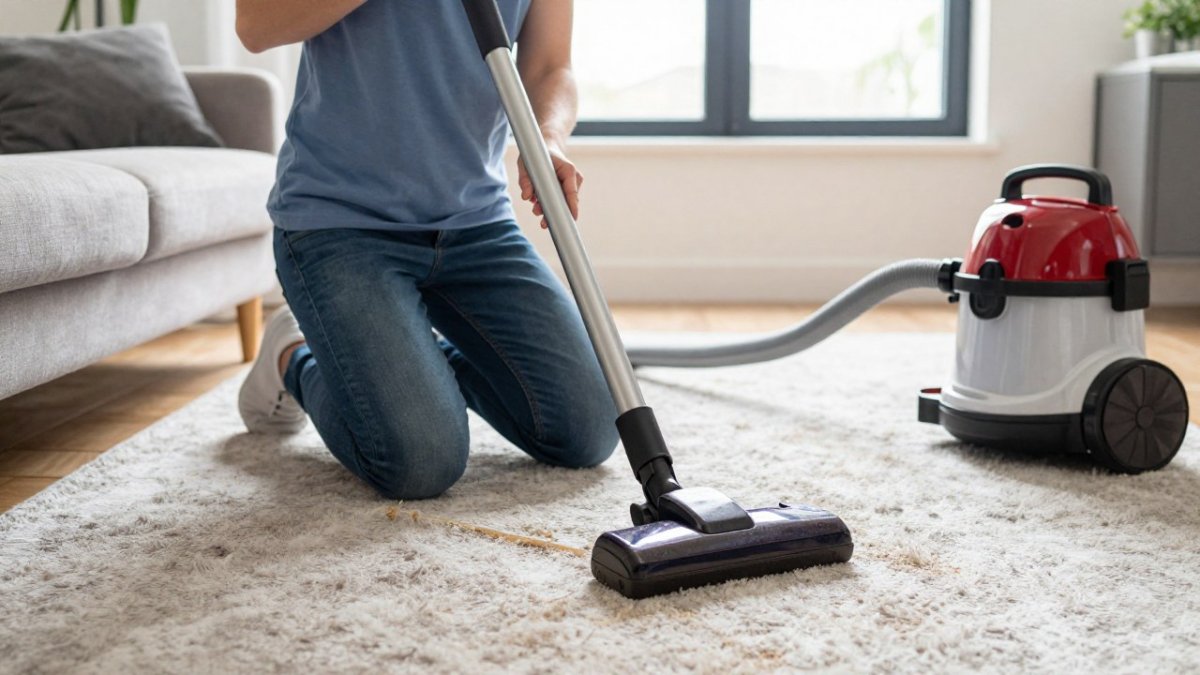
A safe removal sequence for most carpets looks like this:
- Confirm the area is safe to enter. Wait for the fire service to confirm the building is safe, and keep the room ventilated without running fans that blow soot around.
- Remove loose soot dry first. Use a vacuum with a HEPA filter on the lowest suction that still picks up debris. Go slowly in one direction, and empty the vacuum outside because the dust is fine enough to escape the bag.
- Test before you treat. Choose a hidden corner and apply a small amount of any cleaning product. Wait for it to dry and check for colour change, shrinkage or backing delamination before continuing.
- Treat the residue by type. Dry soot lifts with dry methods; oily smoke film needs a suitable cleaning agent matched to the fibre. Work in small sections and blot rather than scrub.
- Rinse and extract. Remove cleaning residue with a clean water rinse and extraction, because leftover product attracts dirt and can hold odour.
- Dry fully and quickly. Use ventilation and gentle air movement to dry the carpet and underlay, since damp backing can grow mould within a day or two.
Method selection depends on the residue and the carpet. Dry methods such as HEPA vacuuming and dry sponges suit loose ash and light surface soot. Extraction methods suit oily film and deeper contamination but add moisture, so they need controlled drying. Deodorisation treats odour but does not remove the source, so it should follow cleaning rather than replace it.
Fibre and backing cautions matter. Wool and natural fibres can shrink or felt with too much moisture or agitation. Synthetic loop pile can unravel if snagged. Woven backing and secondary backing can delaminate if soaked. Always check the manufacturer’s label and test a hidden area first.
Watch out: a damp cloth dragged across soot turns it into a black paste that is much harder to remove. Keep the carpet as dry as possible until the loose soot is gone.
- Vacuum dry soot first, slowly, with a HEPA filter
- Do not rub or scrub stains
- Test any product on a hidden area before use
- Match the method to the residue and the carpet fibre
- Rinse, extract and dry fully to prevent mould and lingering odour
The removal sequence below sums up the key steps and timings from this section.
| Step | What to do | Time or check |
|---|---|---|
| Confirm safety | Wait for fire service clearance; ventilate without fans | Before entering |
| Remove dry soot | Vacuum with HEPA filter, lowest suction | Go slowly, one direction |
| Test product | Apply to hidden corner, check for change | Wait until dry |
| Treat residue | Match method to residue; blot, don’t scrub | Work in small sections |
| Rinse and extract | Clean water rinse and extraction | Remove all product |
| Dry fully | Ventilate and gently move air | Within a day or two |
How to Remove Smoke Smell from Carpet and Furnishings
Smoke odour sits in the fibres and padding, so a surface wipe will not fix it. Ventilation helps, but the real work is in cleaning the carpet and fabric properly. Once the loose soot is removed, clean with a method suited to your carpet type, and let the carpet dry fully before you judge the result.
Upholstery and soft furnishings can often be treated the same way. Check the manufacturer’s label before using any liquid, as some fabrics shrink or stain easily.
- Ventilate the room and keep it dry while you work
- Clean the carpet with a method suited to its fibre type
- Air out cushions, curtains and soft toys in the open air
- Re-test the smell once everything is completely dry
For stubborn odours in soft furnishings, you may need more specialist help. Our guide on removing stubborn organic odours from upholstery covers that process step by step.
When to Call a Professional Carpet Cleaner or Restoration Team
DIY is fine for light, dry soot on a small area. Call a professional when the damage is widespread, when the carpet is wet or mouldy, or when the smell persists after cleaning. Heavy smoke from a house fire usually needs specialist equipment and chemicals that are not sold for home use. Entrusting these complex restoration tasks to professional soot cleanup services ensures that hazardous particulates are fully extracted from the carpet fibers and underlying padding.
A clear decision framework helps. Treat it as three questions:
- Is the residue dry and local? Light surface soot in one area can often be handled with HEPA vacuuming and careful spot treatment.
- Is the contamination wet, widespread or odorous? Wet carpet, mould, or smell that returns after cleaning points to residue in the backing and underlay, which home cleaning rarely reaches.
- Is the space safe to work in? If anyone has asthma or breathing problems, or if the fire involved synthetic materials, get professional advice before cleaning.
Cost and insurance need planning. Pricing depends on the size of the job and the level of contamination, so request a quote and ask what it includes. Before cleaning, photograph everything for insurance records, keep receipts, and ask for a written report if you are claiming. Check your policy before deciding between restoration and replacement.
Verification matters after any clean. Re-check the carpet once it is completely dry: look for returning stains and smell the area close to the backing. Masking an odour is not the same as removing its source, so if the smell returns, the residue is still present and further treatment or replacement may be needed.
- Call a professional for wet, mouldy or heavily soiled carpet
- Get help if the smell remains after a full clean
- Photograph damage and keep receipts for insurance
- Ask for a written report and several quotes
- Verify results after drying, not while the carpet is still damp
When to Replace Carpet After Smoke Damage
Some carpets cannot be saved. If the stain is deep and the smell returns after cleaning, the residue is probably in the underlay and backing. Replacing the underlay along with the carpet is often the only lasting fix.
Compare the cost of restoration with replacement before you decide. Professional restoration costs vary with the size of the job and the level of damage. Replacement may cost more upfront but can be the better choice for badly affected rooms.
- Replace carpet if odour returns after professional cleaning
- Replace it if the underlay is wet, mouldy or stained through
- Consider replacement when restoration costs approach replacement costs
- Check your insurance policy before deciding
Booking Your Smoke-Damage Carpet Clean in Stockport
Carpet Cleaning In Stockport provides deep-cleaning services for carpets and upholstery. Our experienced technicians use family-friendly, pet-safe solutions and advanced equipment. Contact us for a quote, and we will explain what the job involves before we start.
Ready to restore your home? Contact Carpet Cleaning In Stockport and let our experienced technicians help you get your carpets and furnishings back to a healthy, fresh state.
Frequently Asked Questions
Can carpet be cleaned after smoke damage?
In many cases, yes. Light smoke residue and surface soot can often be removed with careful dry vacuuming. Heavy contamination, deep staining or persistent odour may need specialist treatment, and in some situations the carpet is better replaced. A professional inspection will show which option is realistic for your carpet and fire site.
How do you remove smoke smell from carpet after a fire?
Start by ventilating the room and removing loose soot with a HEPA-filtered vacuum, working in one direction and avoiding rubbing. Professional cleaning with suitable residue-removal solutions and thorough drying helps remove the odour at source. Odour neutralisers alone rarely work, because the smoke particles remain in the carpet fibres and underlay until they are properly extracted.
Should you vacuum soot from a fire-damaged carpet?
Yes, but only with a HEPA-filtered vacuum and only before any wet cleaning. Dry vacuuming lifts loose soot without smearing it into the fibres. Never rub or scrub soot, because this drives the particles deeper and can create permanent staining. Vent the room, wear a disposable mask and gloves, and seal the vacuum’s exhaust filter carefully when disposing of it.
How do you know if smoke-damaged carpet needs replacing?
Replacement is usually considered when soot has penetrated the backing and underlay, when the smell persists after professional cleaning, when the fibres are melted or discoloured, or when the carpet has been wet for an extended period and mould is a risk. A professional assessment with documented findings will help you decide and support any insurance claim.


