Last Updated: October 23, 2026
Quick Summary
Preventing carpet wear in high traffic hallways means intercepting grit at the door with mats, adding a gripped runner along the main walking line, and vacuuming the traffic lane slowly and often. Shift furniture and rotate rugs to spread the load, rake flattened pile, and follow a cleaning schedule matched to your household traffic.
- A scraper mat outside and an absorbent mat inside trap shoe-borne grit before it reaches the carpet.
- For a busy hallway, look for a density factor above 3,000 and at least 30 oz/yd² face weight.
- A low-profile runner gripped with a rug pad takes the footfall so the fitted carpet does not have to.
- Vacuum traffic lanes slowly with overlapping passes; two slow passes beat five quick ones.
- High-traffic homes with pets and children should vacuum lanes daily and deep clean every 6-9 months.
Table of Contents
- Why Hallway Carpet Wears Faster Than Any Other Room
- Choosing Carpet That Resists Wear: Measurable Selection Criteria
- How to Prevent Carpet Traffic Lanes From Forming
- Hallway Carpet Runners: The Cheapest Wear Protection You Can Buy
- Vacuuming High-Traffic Carpet: Technique and Equipment Settings
- A Maintenance Schedule Based on Household Traffic
- Professional Carpet Cleaning for Busy Areas: When DIY Stops Working
- Frequently Asked Questions
Why Hallway Carpet Wears Faster Than Any Other Room
Hallway carpet takes more punishment than any other floor in the house: every shoe, pet and shopping bag crosses it. At Carpet Cleaning In Stockport, we see the same pattern in home after home, the hall looks tired years before the lounge does.
A hallway funnels all foot traffic over the same narrow strip, which collects grit from outside. That grit acts like sandpaper under every step, so preventing carpet wear in high traffic hallways starts with understanding that concentrated load.
The Four Forces That Break Down Carpet Fibres
Four things destroy hallway carpet, and they work together:
- Abrasion. Grit and soil grind against fibres with every footstep.
- Compression. Constant weight flattens the pile in traffic lanes.
- Friction. Slipping rugs and scuffing shoes pull fibres loose.
Each force is manageable. Ignore all four and the carpet fails early.
Choosing Carpet That Resists Wear: Measurable Selection Criteria
The best carpet for a busy hall is a tight, dense loop pile made from a durable synthetic fibre; loose, deep pile crushes fast under constant footfall. What separates a carpet that lasts is not the marketing label but measurable specifications you can ask for by name.
The Numbers That Predict How a Carpet Ages
When you shop, ask for these figures rather than vague terms like “heavy domestic” or “commercial grade”; a reputable retailer should supply them for any sample.
- Pile density. Measured in ounces per cubic yard (oz/yd³) or as a density factor. Higher density means less room for dirt to sink in and better bounce-back. For a busy hallway, look for a density factor above 3,000, many durable loop piles sit in the 3,500-5,000 range. Press your thumb in; fibres should spring back fast.
- Face weight. The weight of fibre per square metre (or square yard) on the surface. Heavier face weight means more fibre to wear through, but only when density is also high, a heavy but loosely tufted carpet will still mat. Look for at least 30 oz/yd² (about 1,000 g/m²) for a hallway.
- Twist level. For cut-pile carpets, twist is the number of turns per inch of yarn. Higher twist (typically 5-8 turns per inch) holds the fibre upright and resists flattening. Low-twist, soft yarns feel lovely but crush quickly.
Fibre and Pile Style: The Trade-Offs
Synthetic fibres win on durability and stain resistance in a hallway. Nylon is the most resilient common fibre; polypropylene (olefin) is highly stain-resistant and budget-friendly but less resilient to crushing; polyester sits between the two, with good stain resistance but a tendency to mat under heavy point loads.
For pile style, a tight loop or cut-and-loop construction is the practical choice. Loops resist crushing and are easy to vacuum but can snag on pet claws or high heels; cut-and-loop gives similar resilience with less snag risk.
A Sample-Testing Routine You Can Do in the Shop
- Fold the sample corner to corner and press. If the backing shows through easily, density is low.
- Press your thumb firmly into the pile for five seconds and release. Fast recovery is a good sign; a lasting dent is not.
- Rub the surface with your palm against the pile direction. Excessive shedding suggests a loose construction.
- Ask for the spec sheet and compare density, face weight and twist across your shortlist rather than judging by feel alone.
- Check the warranty terms, many manufacturers tie wear warranties to specific underlay and installation requirements, so read the small print.
Denser, shorter pile has less fibre to crush, and these numbers let you compare candidates on equal terms instead of guessing from showroom hand-feel.
How to Prevent Carpet Traffic Lanes From Forming
Traffic lanes form where feet always land in the same place, in a hallway, almost everywhere, because the corridor funnels every journey over the same narrow strip. Breaking the pattern and spreading the load is the goal, but the routine has to fit a hall, not an open-plan lounge.
A Hallway-Specific Prevention Plan
Work through this in order. Each step targets a different force, abrasion, compression, friction or soiling, so skipping one leaves a gap.
- Intercept grit at the door. A scraper mat outside and an absorbent mat inside trap shoe-borne grit before it reaches the carpet. Shake or vacuum the mats weekly; a loaded mat stops working.
- Add a runner down the main walking line. A runner takes the footfall so the fitted carpet does not have to. Choose a low-profile runner that lies flat and grip it with a rug pad or anti-slip underlay, leaving a small border of carpet visible on each side.
- Shift the load. Move furniture, coat stands and shoe racks slightly every few months so pressure marks migrate. Rotate rugs end to end so wear evens out.
- Rake the pile. A carpet rake lifts flattened fibres between deep cleans. Work in the pile direction, not against it, and go gently over loop pile to avoid snagging.
- Vacuum the lane more often than the edges. The centre strip collects the most grit, so give it an extra pass or two each week. Slow, overlapping strokes beat a quick once-over.
- Deal with spills immediately. Blot, do not rub. A spill left to set becomes a stain that attracts fresh soil and makes the lane look worse.
- Keep the hall dry. Wet carpet compresses more easily and traps dirt, so wipe wet shoes at the door and stay off damp carpet until it is fully dry.
Diagnose Before You Treat: Wear, Dirt, Matting or Fibre Damage?
Not every tired patch is wear, and treating the wrong cause wastes money. Before you book a clean or reach for a rake, identify what you are looking at.
- Dirt. Lifts with a proper vacuum and wash; looks dull and grey, often darker in the lane. If a white cloth rubbed over the pile comes away grubby, it is soil.
- Matting. Fibres are flattened but recover with raking and cleaning. The pile may look crushed but the backing is not visible and the fibres still have body.
- Wear. The pile is thin and the backing shows through in the lane. This is fibre loss, not soil, cleaning will not restore it.
A simple fingernail test helps: scrape a hidden patch of pile. If fibres spring back, it is dirt or matting. If they stay flat or break, it is wear or fibre damage, and cleaning will not fix it.
When Prevention Is No Longer Enough
If the lane is worn through to the backing, rippled, or the carpet has delaminated, prevention has run its course. Ripples and loose areas can often be re-stretched by a fitter; localised wear can sometimes be patched with spare carpet. Where the pile is worn across the full width of the hall, replacement is usually the practical answer, and the selection criteria above will help you choose better next time.
Before you pay for a deep clean, run the fingernail test on a hidden patch. If fibres spring back, it is dirt or matting and cleaning will help. If they stay flat or break, it is wear, and cleaning will not fix it.
Hallway Carpet Runners: The Cheapest Wear Protection You Can Buy
A hallway runner is the single best value defence against wear. It takes the footfall so your fitted carpet does not have to.
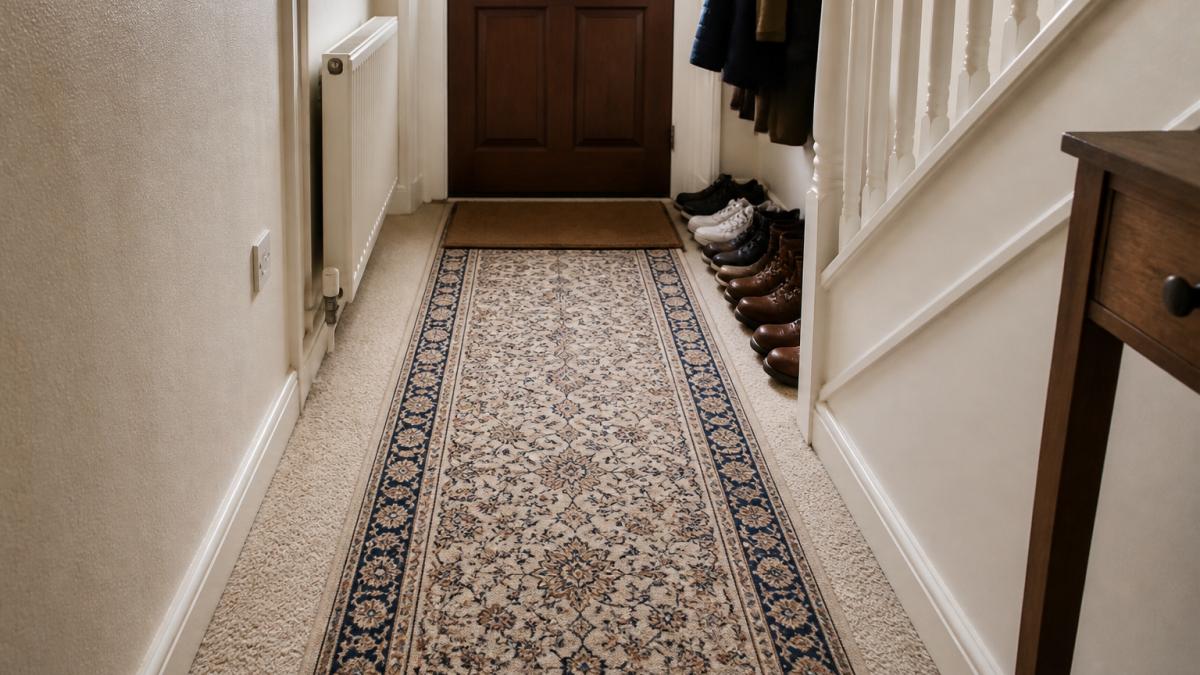
Choose a low-profile runner that lies flat. A washable rug suits busy homes with pets, because you can clean it without touching the main carpet. Match the runner width to leave a small border of carpet visible on each side.
Gripping, Edges and Safety
A loose runner is a trip hazard. Always use a rug pad or anti-slip underlay to reduce friction and keep the runner in place. Check the edges regularly for curling, and replace worn grippers before they fail.
For households with young children or older residents, a flat, well-gripped runner is safer than a thick, soft one. Slip prevention matters as much as wear protection.
Vacuuming High-Traffic Carpet: Technique and Equipment Settings
Vacuuming high-traffic carpet properly removes the grit that causes abrasion. Most people vacuum too fast and miss the embedded dirt.
Slow down and overlap your passes. Two slow passes beat five quick ones.
- Set the height right. The brush should touch the pile, not drag or float.
- Use the brush bar on loop pile to agitate and lift soil.
- Go slow over traffic lanes, roughly half your normal speed.
Regular vacuuming is the cheapest wear protection there is. If you do not own a machine, our guide on how to clean high-traffic carpet areas without a machine walks through a practical method.
A Maintenance Schedule Based on Household Traffic
Match your cleaning to how many feet cross the hall. A busy family home needs more frequent care than a quiet flat.
| Household traffic | Vacuum traffic lanes | Deep clean | Rake pile |
|---|---|---|---|
| Low (1-2 people, no pets) | Twice weekly | Every 12-18 months | Monthly |
| Medium (family, occasional pets) | 3-4 times weekly | Every 9-12 months | Fortnightly |
| High (pets, children, visitors) | Daily | Every 6-9 months | Weekly |
Stick to the schedule and the hall stays presentable far longer; skip it and soil works deeper, speeding up wear.
Professional Carpet Cleaning for Busy Areas: When DIY Stops Working
Professional carpet cleaning for busy areas does what a home machine cannot: it flushes out deep embedded dirt and resets the pile. DIY cleaning often leaves sticky residue that attracts fresh soil, so the carpet looks dirty again within days.
If you run a business with a busy entrance, one-off cleaning rarely keeps up. Ongoing professional maintenance is the practical answer, and you can book contract carpet cleaning in Stockport for businesses on a regular schedule.
Wear, Dirt, Matting or Fibre Damage? How to Tell the Difference
Not every tired patch is dirt. Diagnose it first:
- Dirt: lifts with a proper vacuum and wash; looks dull and grey.
- Matting: fibres are flattened but recover with raking and cleaning.
- Wear: the pile is thin and the backing shows through in the lane.
Dirt and matting respond to cleaning. If you have crushed pile rather than worn-through carpet, our guide to DIY carpet pile restoration techniques covers seven methods that work.
Wondering whether to clean it yourself or call in help? Our comparison of professional vs DIY carpet cleaning looks at which lasts longer in busy areas.
Hallway carpet will always take more punishment than the rest of the house, but a runner, the right vacuuming and a traffic-based cleaning schedule keep it looking sharp for years.
Frequently Asked Questions
How often should I vacuum a busy hallway carpet?
A hallway used by the whole household several times a day needs vacuuming at least three to four times a week, and daily if you have pets or children who bring in grit. Grit acts like sandpaper underfoot, so the faster you remove it, the slower the fibres abrade. Use a slow, overlapping pass rather than a quick once-over, and switch the beater bar on for synthetic fibres but off for loop pile and wool. If visitors arrive muddy or after a rainy walk, vacuum that evening rather than waiting for the weekly clean.
Do hallway carpet runners actually help protect carpet from wear?
Yes. A runner takes the foot traffic and friction instead of the carpet underneath, so the wear pattern forms on a replaceable item rather than on a fitted floor. Choose a runner that covers the main walking line, add a non-slip rug pad underneath to stop it creeping, and rotate it end to end every few months so the wear is spread evenly. Washable rugs are a practical choice for households with pets or young children, and a runner is far cheaper to replace than a whole hallway of carpet.
Can professional carpet cleaning help prevent carpet wear?
It helps, mainly by removing embedded dirt and sticky cleaning residue that traps more soil. Deep cleaning also lifts flattened fibres and improves carpet appearance, but it cannot repair fibres that are already broken. Book professional carpet cleaning for busy areas once or twice a year in a hallway, and deal with spillages promptly rather than waiting for the annual clean. Always confirm drying times before booking, because a carpet left wet for days can smell musty and attract fresh dirt.
How do I tell whether my hallway carpet is worn or just dirty?
Look closely at the traffic lane in good light. Dirt and matting sit on the surface and respond to vacuuming and cleaning, while wear shows as flattened, frayed or lighter-coloured fibres that stay that way after cleaning. Run a carpet rake or your fingers across the pile: fibres that spring back are matted, and fibres that stay crushed or feel thin are damaged. If the backing shows through in the centre of the lane, the carpet is beyond cleaning and replacement or a runner is the practical answer.