Table of Contents
- The Real Reason Your Carpet Feels Crunchy After Cleaning
- Soap Residue: The Hidden Cause of Stiff Carpet Pile
- Hard Water and Mineral Deposits in Carpet Fibres
- Carpet Cleaning Residue Removal: How to Strip Detergent Buildup
- How to Soften Stiff Carpet Fibres at Home
- Carpet Drying Time After Professional Cleaning (And Why It Matters)
- Why Crunchy Carpet Attracts Dirt (And How to Break the Cycle)
- Frequently Asked Questions
Last Updated: September 12, 2026
The Real Reason Your Carpet Feels Crunchy After Cleaning
If you’ve ever walked across a freshly cleaned carpet and felt it crackle underfoot like dry grass, you’ve experienced one of the most common frustrations in carpet care: why do carpets get crunchy after cleaning? At Carpet Cleaning In Stockport, we see this complaint regularly, and the cause is almost never the cleaning itself. It’s what gets left behind.
Crunchy carpet is a carpet that still contains dried residue, whether that’s detergent, minerals from hard water, or both. When moisture evaporates, these dissolved solids stay in the pile and harden around each fibre. The result is a stiff, gritty texture that feels unclean even when it looks spotless.
The good news: it’s fixable, and in most cases you can prevent it entirely. Below, we’ll break down exactly what causes that crunch, how to strip out residue, and how to soften stiff carpet fibres at home.
Crunchy carpet is not a sign of over-cleaning. It’s a sign of incomplete rinsing. The fix is almost always more water extraction, not less cleaning.
Soap Residue: The Hidden Cause of Stiff Carpet Pile
Soap residue is the single biggest reason carpet feels stiff after cleaning. Most carpet shampoos and household detergents are alkaline by design, which helps them lift oily soil from synthetic fibres. The problem is what happens when they aren’t fully rinsed out.
As the carpet dries, leftover detergent crystallises around the base of each fibre. This is called detergent buildup, and it does two things: it stiffens the pile, and it creates a sticky surface that grabs new dirt within days. That’s why a carpet can look clean on Monday and grubby again by the weekend.
A common mistake is assuming more shampoo equals a deeper clean. In practice, the opposite is true. Over-application leaves more residue behind, and rental machines with weak suction power simply cannot pull it all out.
- Alkaline shampoos lift soil well but leave the most residue if not rinsed
- Powder cleaners can leave gritty crystalline deposits in the pile
- Foam cleaners often sit on top of fibres rather than penetrating
- Weak extraction is the root cause in nearly every crunchy-carpet case
Hard Water and Mineral Deposits in Carpet Fibres
Hard water leaves mineral deposits in carpet fibres every time you clean. Water in many parts of the region carries dissolved calcium and magnesium, and when that water dries, those minerals remain as a fine chalky film. The harder the supply, the more pronounced the effect, and the more cleans it takes to notice, because the film builds in layers rather than appearing all at once.
Not all fibres hold onto those minerals equally, and this is where most guides stop short:
- Wool and other protein fibres have a scaly outer cuticle that traps calcium carbonate crystals. Once lodged, they are difficult to rinse free and can leave wool feeling brittle rather than merely stiff.
- Nylon and polyester are smoother and shed most mineral film with a good rinse, but their slight surface charge attracts the fine chalky particles, which is why synthetics can still feel gritty even when the water was soft.
- Polypropylene (olefin) is the most resistant to mineral retention, but it mats easily when residue is left behind, so the crunch shows up as flattening rather than grittiness.
- Blended and loop-pile carpets hide deposits in the base of the loop, where suction is weakest, so the stiffness is felt rather than seen.
You’ll notice the problem most on dark carpets, where a greyish haze appears after cleaning, and on wool or other natural fibres, which hold onto minerals more stubbornly than synthetics. Over repeated cleans, the buildup compounds. Each wash adds another layer, and the carpet gets progressively stiffer.
The pH balance of your cleaning solution matters here too. Hard water pushes solutions more alkaline, which means you need slightly more product to get the same cleaning effect, which in turn means more residue. A rinsing agent or a mildly acidic rinse helps neutralise both the alkalinity and the mineral film. As a rule of thumb, a rinse solution in the mildly acidic range, around pH 5 to 6, dissolves calcium carbonate far more readily than a neutral or alkaline one, which is why acidic rinses are standard practice on wool and on any carpet cleaned with a high-alkaline pre-spray (hse.gov.uk).
If your tap water leaves spots on glassware, it will leave minerals in your carpet. A simple water hardness test kit costs very little and tells you whether you need an acidic rinse as standard. If you are on a metered or softened supply, check whether the softener uses sodium exchange, the sodium still leaves a residue, just a different one.
A common pattern is that a carpet cleaned repeatedly with hard water and an alkaline shampoo reaches a point where no amount of plain-water rinsing restores softness. At that stage the minerals and the detergent have effectively bonded into the pile, and the fix is a dedicated acidic rinse followed by thorough extraction, not another shampoo pass.
Carpet Cleaning Residue Removal: How to Strip Detergent Buildup
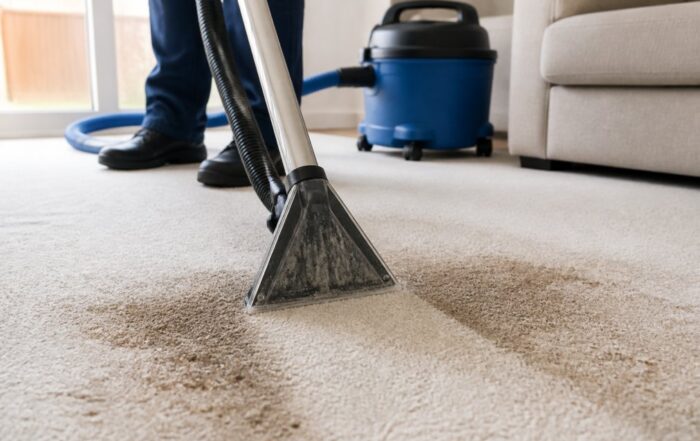
Carpet cleaning residue removal comes down to one principle: dissolve the dried solids, then extract them completely. You cannot vacuum crystallised detergent out of a carpet pile. It has to be re-wetted and pulled out with strong suction.
Here’s the sequence that works:
- Vacuum thoroughly first. Dry soil removal means less detergent needed later.
- Pre-treat with a diluted, pH-balanced solution. Avoid over-concentrating.
- Agitate gently with a soft brush to lift residue from the fibre base.
- Rinse with clean water, repeating until the extracted water runs clear.
- Extract with strong suction power, passing slowly over each area twice.
- Repeat the rinse on any section that still feels stiff once dry.
The tell-tale sign you’ve succeeded is the colour of the water coming out. If it’s still cloudy after two rinses, there’s still residue in the pile.
How to Soften Stiff Carpet Fibres at Home
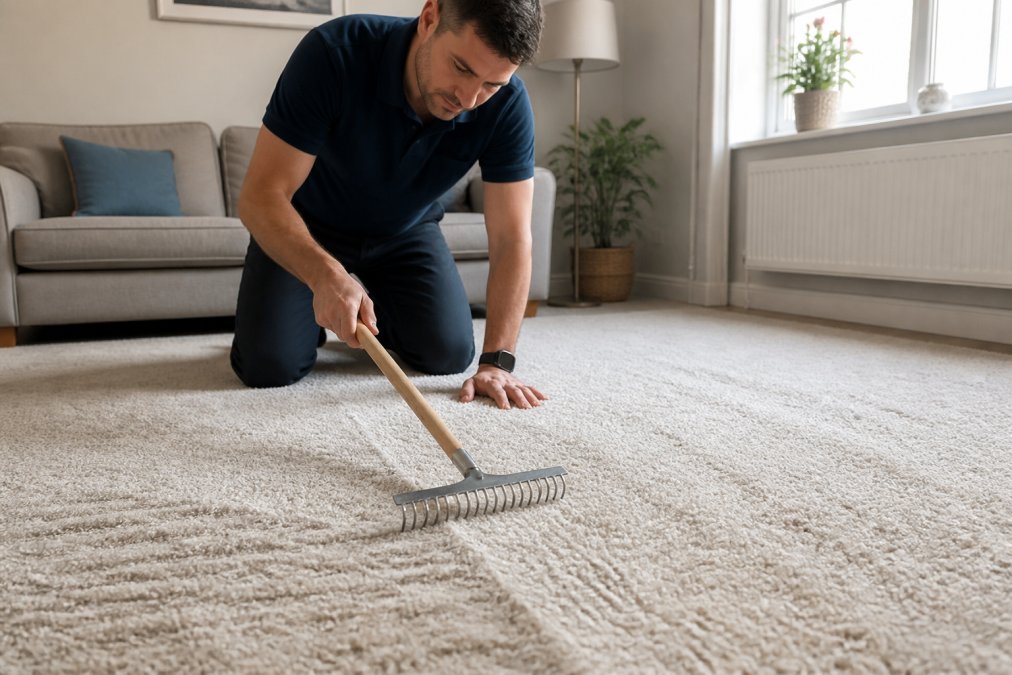
To soften stiff carpet fibres at home, you need to remove what’s hardening them, not just add softness on top. No spray or conditioner will fix a carpet that still has detergent locked into the pile.
Start by re-rinsing the affected area with plain warm water and extracting it thoroughly. If you don’t own an extractor, a wet vacuum can work on small sections, though it won’t match professional suction power. Once the carpet is clean, break up the matted pile with a carpet rake or a stiff-bristled brush. This lifts fibres that have been flattened and glued together by residue.
For light cases, a diluted white vinegar rinse can help neutralise alkaline detergent before a final water extraction. Test on a hidden patch first, particularly on wool or natural fibres.
- Re-rinse the stiff area with warm water
- Extract until the water runs clear
- Rake or brush the pile to lift matted fibres
- Allow full airflow while drying
- Vacuum once completely dry to fluff the pile
Carpet Drying Time After Professional Cleaning (And Why It Matters)
Carpet drying time after professional cleaning should be measured in hours, not days. When a carpet stays damp for 24 hours or more, two things happen: fibres stay flattened under the weight of moisture, and dampness encourages odours and mould in the backing (the NHS).
There is a third effect that most guides never mention, and it is the one that actually causes the crunch. Residue does not simply dry onto the fibre, it crystallises. As water evaporates, the concentration of dissolved detergent and minerals in the remaining moisture rises until the solution becomes saturated and solid crystals form around the base of each tuft. The slower the carpet dries, the longer that solution stays mobile and the more thoroughly it wicks down into the pile and backing before setting. A carpet that dries in four hours with strong airflow forms smaller, more superficial crystals that vacuum away easily. A carpet that dries over two days forms larger, harder deposits bonded deep into the fibre base, and those are the ones you can feel underfoot weeks later.
This is why drying is not just a comfort issue. It is the final stage of the cleaning chemistry, and it determines whether the residue left behind is removable or permanent.
Proper drying depends on four things working together:
| Factor | Why It Matters | What Good Looks Like |
|---|---|---|
| Suction power | Removes the water that carries dissolved residue | Carpet feels damp, not soaked |
| Airflow | Evaporates remaining moisture evenly and quickly | Windows open, fans running, air moving across the pile |
| Dehumidification | Stops moisture settling in the backing | Room humidity drops steadily rather than climbing |
| Temperature | Warm air holds more moisture and speeds evaporation | Room kept warm, not cold, during drying |
A practical target is to have the carpet touch-dry within four to six hours and fully dry within twelve. To get there, aim for cross-ventilation rather than a single open window, position fans so air moves across the carpet surface rather than straight down onto it, and run a dehumidifier in the room if the weather is damp or the space is poorly ventilated. Closing doors to contain the drying area helps the dehumidifier work faster. Avoid walking on the carpet while damp, as foot traffic presses residual moisture and dissolved solids deeper into the pile.
Oversaturation is the enemy here. A carpet that’s been soaked through takes far longer to dry, and the longer it stays wet, the more the pile mats down. Professional hot water extraction is designed to clean deeply while pulling most of the water back out in the same pass. If you are cleaning at home, pass the wand slowly and overlap each stroke, the extra seconds of suction remove far more water than a fast second pass ever will.
If your carpet still smells musty two days after cleaning, it wasn’t dried properly (the NHS). Trapped moisture in the backing is the cause, and it needs addressing before the carpet is used again. If the crunch returns within a week despite the carpet feeling dry, the residue crystallised during a slow dry and needs a further rinse and extraction.
A useful check: press a dry white towel into the pile a few hours after cleaning. If it comes away feeling slightly stiff or chalky rather than merely damp, residue is still present and the drying phase has not finished cleanly.
Why Crunchy Carpet Attracts Dirt (And How to Break the Cycle)
Crunchy carpet attracts dirt because sticky residue grabs it. This is the cycle most people never break: clean the carpet, leave residue, watch it get dirty faster, clean it again, add more residue.
The residue acts like a magnet for everyday soil, pet hair, and airborne particles. Within a week the carpet looks worse than before you cleaned it, which leads to more frequent cleaning and more buildup. Left long enough, this causes fibre matting and a permanently stiff texture that no amount of home cleaning will fix.
Breaking the cycle means one thorough professional clean that prioritises residue removal over surface appearance. Deep cleaning that includes proper rinsing and extraction resets the carpet, removing both the accumulated detergent and the minerals underneath it. After that, regular vacuuming and prompt spot cleaning keep it soft far longer.
At Carpet Cleaning In Stockport, our technicians use family-friendly, pet-safe solutions and high-powered extraction to remove dirt, allergens, and residue, with fast drying times that prevent the dampness that causes stiffness in the first place. Residents across the area have trusted us to restore carpets to their original quality, from family homes with pets to commercial offices and rental properties needing end-of-tenancy cleaning.
If your carpet feels stiff, gritty, or rough no matter how often you clean it, the problem is residue, not effort. Carpet Cleaning In Stockport can strip out detergent buildup and mineral deposits with a deep cleaning process that removes hidden contaminants and restores softness to the pile. Our experienced technicians use family-friendly, pet-safe solutions, offer same-day service, and deliver fast drying times so your carpet is soft, fresh, and ready to walk on sooner. Get started with Carpet Cleaning In Stockport and feel the difference underfoot.
Frequently Asked Questions
How to get rid of crunchy carpet after cleaning?
The fix depends on the cause. If detergent residue is the culprit, mix one part white vinegar with four parts water and mist it lightly over the affected area, then work it in with a soft brush. Rinse by blotting with clean water and a towel. For hard water minerals, a dedicated residue remover from a carpet supplier works better. After treating, dry the carpet quickly with airflow. If the stiffness returns, the cleaning solution itself is likely the problem, so switch to a low-residue or pH-balanced product.
How long does it take for carpet to dry after getting it professionally cleaned?
With proper hot water extraction and good ventilation, most carpets dry within 4 to 6 hours. Dense wool carpets or rooms with poor airflow can take 12 to 24 hours. If your carpet stays damp longer than that, the technician likely used too much water or did not extract it properly. Ask about drying time before booking, and run a dehumidifier or open windows afterwards to speed things up and prevent musty odours.
Is crunchy carpet a sign of poor cleaning techniques?
It can be. Over-wetting, using too much shampoo, or skipping the rinsing step all leave residue behind that stiffens fibres as it dries. That said, some crunchiness is normal for a day or two after cleaning while the carpet finishes drying. If the stiffness persists beyond 48 hours, or if the carpet feels sticky rather than just stiff, the cleaning technique is the likely cause. A proper hot water extraction process with a rinsing agent should leave fibres soft, not crunchy.
Why does my carpet crunch when I walk on it?
That crunching sound usually comes from crystallised detergent or mineral deposits trapped at the base of the carpet pile. As you walk, the fibres rub against these hard particles, creating a crunching or crackling noise. It is common after DIY cleaning with too much shampoo, or after repeated wet cleaning without adequate rinsing. A deep residue removal treatment, followed by proper extraction and fast drying, will usually eliminate the sound and restore a soft feel underfoot.