Table of Contents
- Why Hidden Pet Urine Stains Are Harder to Find Than Visible Damage
- Using UV Light to Detect Urine: Finding the Best UV Torch for Pet Urine
- Step-by-Step: Locating Stains in Carpet and on Hard Floors
- How to Remove Pet Urine Smell from Carpet: Enzyme-Based Cleaner Application
- Treating Wood Floors and Hardwood Stains Safely
- Professional Pet Odour Removal Services: When to Call In Experts
- Preventing Future Accidents and Re-Marking Behaviour
- Frequently Asked Questions
Last Updated: September 24, 2026
Why Hidden Pet Urine Stains Are Harder to Find Than Visible Damage
Pet urine creates two problems. The first is what you see: a wet patch or discoloration on carpet or hard flooring. The second is what you don’t: uric acid crystals that soak deep into carpet fibres, padding, and sub-floors. To find hidden pet urine stains, you must look beyond the visible surface, as these invisible stains continue to smell and can trigger re-marking behaviour long after the surface looks clean.
Most DIY cleaning methods address only the visible stain. A quick blot with paper towels removes surface moisture. A standard carpet cleaner tackles the top layer of fibres. But the uric acid crystals remain embedded deeper down, invisible to the naked eye, waiting to reactivate when humidity rises or the area gets wet again.
This is where many pet owners get frustrated. They clean, the carpet dries, and within days or weeks the smell returns. The stain hasn’t gone away, it was never fully found in the first place.
At Carpet Cleaning In Stockport, we’ve worked with homes where pet accidents have left hidden damage. The difference between a successful clean and a failed one almost always comes down to detection. You can’t remove what you can’t find. That’s why finding hidden pet urine stains is the critical first step before any treatment begins.
Using UV Light to Detect Urine: Finding the Best UV Torch for Pet Urine
Ultraviolet light reveals what your eyes cannot. When you shine a UV torch across a carpet in a darkened room, uric acid crystals in dried pet urine fluoresce, they glow bright blue or white. This makes it possible to map the full extent of contamination, not just the obvious wet patch.
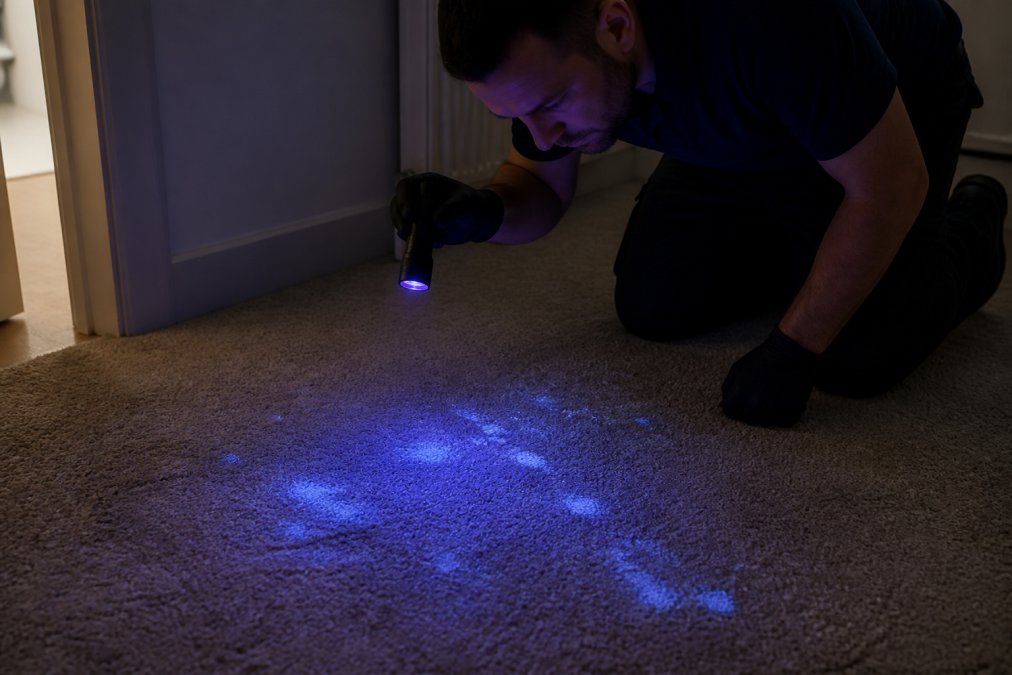
How UV light reveals uric acid crystals
Pet urine contains uric acid. When urine dries, these crystals remain behind. Unlike organic matter that breaks down, uric acid is stable and persistent. It doesn’t dissolve in water alone, which is why a standard rinse won’t remove it.
UV light at wavelengths around 365-395 nanometres causes uric acid crystals to fluoresce. The crystals absorb ultraviolet energy and re-emit it as visible light, typically a bright blue or white glow. This fluorescence is immediate and unmistakable under a UV torch.
The advantage is clear: you can see exactly where the contamination spreads. Often the stain extends far beyond the visible wet area. Urine soaks sideways through carpet fibres and down into padding. A torch shows all of it.
Avoiding false positives with UV detection
Not everything that glows under UV light is pet urine. Other substances fluoresce too: some cleaning residues, certain fabric dyes, lint, dust, and even some types of mould can produce a faint glow. This creates a risk of false positives, treating areas that don’t actually contain uric acid.
The key is understanding the difference. Uric acid glows bright and sharp. False positives tend to glow more dimly or with a different colour. Fresh urine glows more intensely than old, dried urine. If you’re unsure whether a glow is genuine urine or a false positive, mark it with tape and return to it after treatment. Real urine stains will re-glow if not fully removed.
One practical tip: test your UV torch on a known urine stain first. This gives you a baseline for what authentic uric acid fluorescence looks like in your specific carpet or flooring. Then use that reference when scanning other areas.
Step-by-Step: Locating Stains in Carpet and on Hard Floors
To find hidden pet urine stains requires a systematic approach. Don’t rely on smell alone, your nose adapts quickly and misses faint odours. Use UV light combined with physical inspection to build a complete picture of contamination.
Immediate blotting and moisture absorption
Start by identifying fresh or recent accidents. These still contain liquid moisture, which makes them easier to locate and treat.
Use white paper towels or absorbent cloths to blot the area. Press down firmly without rubbing, rubbing spreads the urine deeper into fibres. Blot repeatedly until no more moisture transfers to the towel. This removes surface liquid and prevents it from spreading further.
For carpet, you can place a weighted object (a book or tile) over the damp area for 10-15 minutes to absorb additional moisture. This step matters because moisture trapped in padding creates an environment where odour compounds persist and re-activate.
Checking porous surfaces and sub-floor padding
The real challenge with hidden pet urine stains is that they penetrate below the visible carpet surface. Urine soaks through carpet fibres into the backing and then into the padding underneath. From there, it can even reach the sub-floor itself.
When you suspect a stain but the carpet surface looks clean, you need to check what’s underneath. Carefully lift the carpet edge in the suspected area. Use a UV torch to examine the backing and padding. Look for the bright fluorescent glow that indicates uric acid.
If padding is saturated with urine, it usually needs replacement. No amount of surface cleaning will eliminate odour if the padding remains contaminated. The urine will continue to off-gas and trigger re-marking behaviour.
For hard floors (wood, vinyl, laminate), check the seams and edges where urine can seep underneath. Use the UV torch along baseboards and under furniture where pets commonly mark territory. Urine often spreads laterally along sub-floor surfaces, creating stains that extend well beyond what appears on the surface.
How to Remove Pet Urine Smell from Carpet: Enzyme-Based Cleaner Application
Once you’ve located the stains using UV light, the next step is removal. Standard carpet cleaning won’t work because it doesn’t break down uric acid crystals. You need an enzyme-based cleaner that targets the chemistry of urine itself.
Why enzyme cleaners break down uric acid
Enzyme-based cleaners contain biological enzymes that digest organic compounds. These enzymes break down the uric acid and other proteins in pet urine into smaller molecules that dissolve in water and can be rinsed away.
The process is straightforward but requires patience. Apply the enzyme cleaner directly to the stain and let it sit. The enzymes need time to work, typically 12 to 24 hours, depending on the product. During this time, the enzymes are actively breaking down uric acid crystals. Complete saturation ensures that these stubborn residues are fully neutralized, which is a necessary step when eliminating pet bed odors that often linger even after the primary carpet cleaning is finished.
After the dwell time, rinse the area thoroughly with clean water. The broken-down urine residues rinse away. What remains is a carpet free of the compounds that cause odour and trigger re-marking.
The advantage over standard cleaners is specificity. Enzymes target the exact chemical structure of urine. They don’t just mask the smell or clean surface dirt, they eliminate the source.
Testing products on hidden areas first
Before applying any enzyme cleaner to visible carpet, test it on a hidden area first. Some enzyme products can bleach or discolour certain carpet dyes or synthetic fibres. Testing prevents costly damage.
Apply a small amount of the product to an inconspicuous spot, inside a closet, under a bed, or along a baseboard. Wait 24 hours. Check for discoloration or damage to the carpet fibres. If the test area looks fine, you can proceed with confidence on the main stain.
This step is especially important for older carpets or those with delicate fibres.
Treating Wood Floors and Hardwood Stains Safely
Wood floors present a different challenge. Unlike carpet, wood is porous but also vulnerable to water damage. Urine soaks into the wood grain, and aggressive cleaning can cause swelling, warping, or permanent discoloration.
Professional Pet Odour Removal Services: When to Call In Experts
Sometimes DIY efforts fall short. This happens when contamination is extensive, when the sub-floor is involved, or when previous cleaning attempts have failed to eliminate odour. In these cases, professional intervention makes sense.
Preventing Future Accidents and Re-Marking Behaviour
Finding and removing hidden pet urine stains is only half the battle. Once the carpet or flooring is clean, the next step is preventing the problem from recurring.
Frequently Asked Questions
How can I locate hidden pet urine if I can’t see visible stains?
Use a UV torch (black light) in a darkened room to detect uric acid crystals, which fluoresce under ultraviolet light. Start by scanning high-traffic areas and corners where pets typically mark. You can also follow your nose to areas with strong odours, then use the UV light to confirm. If the smell is present but UV light reveals nothing, the urine may have soaked deep into padding or sub-floor, requiring professional detection equipment.
What’s the best UV torch for pet urine detection?
Look for a UV torch with a wavelength of 365-385 nanometres, which is most effective at revealing uric acid crystals. Handheld models work well for small areas, whilst larger UV lamps are better for scanning entire rooms. Test any torch on a small known urine spot first to confirm it shows clear fluorescence. Avoid very cheap models, as they may not produce strong enough UV output to detect faint or old stains reliably.
How do I remove pet urine smell from carpet once I’ve found the stain?
Enzyme-based cleaners are most effective because they break down the ammonia and uric acid crystals causing the odour. Apply the cleaner directly to the affected area, allow it to sit for the time recommended on the product label (usually 10-30 minutes), then blot thoroughly with paper towels or a clean cloth. For stubborn odours, repeat the process or consider professional pet odour removal services, which use industrial-strength enzyme treatments and deep-cleaning equipment to neutralise odours completely.
Can professional cleaners remove pet urine stains that I can’t get out myself?
Yes. Professional pet odour removal services use specialist equipment, enzyme cleaners, and deep-cleaning techniques that reach urine trapped in carpet padding and sub-floor areas. They can also apply pH-balanced treatments and deodorising solutions that DIY methods cannot match. If home treatment hasn’t eliminated the smell after multiple attempts, or if urine has soaked deep into padding, professional intervention is more cost-effective than replacing the carpet.