Table of Contents
- How Long Does Professional Pet Odor Removal Take? A Realistic Timeline
- What Happens During a Professional Pet Odor Removal Appointment
- How Long Do Carpets Take to Dry After Cleaning?
- Pet Urine Odour Removal: Why Neutralising Beats Masking
- Enzyme Cleaner for Pet Urine: How It Fits Into a Professional Treatment
- Professional Rug Cleaning for Pet Odours: Timelines for Rugs and Upholstery
- What Can Make Pet Odor Removal Take Longer?
- Frequently Asked Questions
Last Updated: October 4, 2026
How Long Does Professional Pet Odor Removal Take? A Realistic Timeline
Most professional pet odor removal appointments take one to three hours of technician time, but the smell is not gone until the carpet has fully dried, adding another four to eight hours.
The biggest misunderstanding is that cleaning and curing are the same event.
Most guides quote a cleaning time and stop there, leaving you sniffing the air two hours later, convinced the job failed when the treatment is simply still working.
Technician Time vs Total Time Until the Smell Is Gone
Technician time is how long our van sits outside your property: usually one to three hours for a standard room. Total time is everything from arrival until the room smells clean, including drying and enzyme dwell time.
A common mistake is judging the result while the carpet is still damp. Damp carpet holds odour molecules in suspension, so a treated room can smell faintly of urine at hour two and clean by hour eight.
- Light contamination, one room: 1-2 hours technician time, 4-6 hours total
- Multiple rooms or repeat marking: 2-3 hours technician time, 8-12 hours total
- Old, set-in stains with subfloor contamination: often needs a second visit
If you have a deadline, such as a move-out inspection, tell us when you book. It changes how we sequence the job.
What Happens During a Professional Pet Odor Removal Appointment
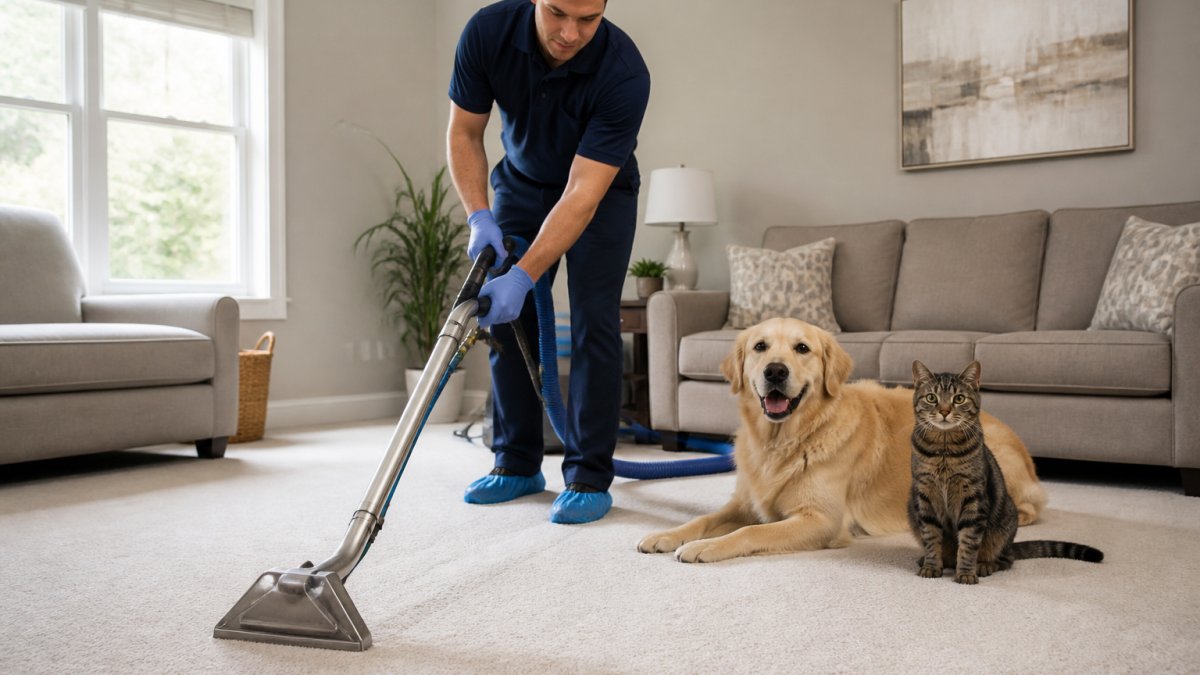
A professional appointment follows five stages: inspection, pre-treatment, deep extraction, enzymatic treatment, and controlled drying. Skipping any one is why do-it-yourself cleaning so often fails.
- Inspection. The technician checks the affected area under a UV lamp. Urine salts and dried residue show up clearly, including patches you cannot smell yet.
- Pre-treatment. A cleaning solution is applied to the contamination and left to dwell. Dwell time matters: the product needs contact time to break down uric acid crystals.
- Deep extraction. Hot water extraction flushes the carpet fibres and lifts loosened contamination out. This is the stage that removes the bulk of the urine residue from the carpet.
- Enzymatic treatment. An enzyme cleaner is worked into the backing and, where needed, the carpet padding. The enzymes digest the uric acid that causes the smell.
- Drying. Air movers and ventilation bring moisture levels down. This stage takes longer than the cleaning itself.
Ask the technician to show you the UV inspection before and after. Urine salts glow under UV light, so you can see for yourself whether the affected area has actually been treated rather than just shampooed.
How Long Do Carpets Take to Dry After Cleaning?
Drying is the longest single stage of a pet odour job, and the one most people misjudge.
The odour is not fully gone until the carpet is dry. While fibres are damp, odour molecules stay in suspension and the room can still smell faintly of urine at hour two or three. That is not a failed treatment, just chemistry still working.
What Actually Controls Drying Speed
Four variables control drying speed:
- Airflow. Moving air carries moisture away from the fibres. A fan or air mover aimed across the treated area does far more than a single open window.
- Humidity. On a damp day, air is already close to saturation and cannot absorb much more moisture. A dehumidifier helps more than an open window.
- Temperature. Warm air holds more moisture than cold. Keeping the heating on in winter speeds evaporation; turning it off to “air the room” slows it down.
- Pile and underlay. A flat, short-pile carpet over thin underlay dries fastest. A deep wool pile over thick sponge underlay holds water far longer, and the underlay is often last to dry.
A Realistic Drying Schedule
| Carpet type | Typical drying time |
|---|---|
| Short-pile synthetic, good airflow | 4-6 hours |
| Medium pile, average conditions | 6-8 hours |
| Thick wool pile or soaked underlay | 8-12 hours, sometimes overnight |
| Humid or cold day, poor ventilation | Add 2-4 hours to any of the above |
When It Is Safe to Walk On, and When Pets Can Return
A common mistake is treating “dry to the touch” as “dry”. The surface can feel dry while the backing and underlay are still damp. As a rule:
- Light foot traffic: usually fine after two to three hours, in socks or clean indoor shoes.
- Furniture back in place: wait until fully dry, typically six to eight hours. Trapped moisture under a sofa or rug can leave a musty smell that mimics the pet odour you just paid to remove, and can stain the backing.
- Pets and children back on the carpet: wait until completely dry. Damp fibres attract dirt, and a pet on a damp treated area can transfer contamination back into the pile.
- Beds and mattresses: allow a full drying cycle, often overnight, before making the bed.
Do not cover a damp carpet with a rug, mat, or furniture. Trapped moisture is the single most common cause of a musty smell appearing a day or two after a successful pet odour treatment. If in doubt, leave it exposed and run a fan for another hour.
How to Speed It Up
- Run air movers for at least the first two hours, longer if the carpet is thick.
- Open windows on opposite sides for cross-ventilation, but only if the outside air is not damp.
- Use a dehumidifier on humid days; it outperforms an open window.
- Keep the heating on in cold weather.
- Do not walk on, cover, or push furniture back onto a damp carpet.
A carpet that stays damp for days grows a musty smell of its own, a separate problem from pet odour, and entirely avoidable with airflow and patience.
Pet Urine Odour Removal: Why Neutralising Beats Masking
Pet urine odour removal works by neutralising the source, not covering it. Masking sprays and scented powders add a fresh smell on top of the contamination; the moment that scent fades, the urine smell returns because the uric acid is still in the carpet. That is why shop-bought deodorisers seem to work for a day and then stop.
What Is Actually in Pet Urine
Urine contains three components that matter for odour:
- Urea, which breaks down into ammonia and gives the sharp, fresh smell.
- Ammonia, which is most noticeable in fresh or recently disturbed urine.
- Uric acid, which forms crystals that bind tightly to carpet fibres, backing, and underlay.
Uric acid crystals are the persistent problem. They are not water-soluble as most people assume, and they release odour whenever humidity rises, which is why a room can smell fine on a dry day and strongly again after a shower, a rainy spell, or a humid evening.
Why Surface Cleaning Fails
A rental machine or mop applies cleaning solution to the surface, lifting some contamination from the fibre tips. The room smells better for a few days, then humidity rises, the uric acid crystals below the surface release odour again, and the smell creeps back. Many households recognise this pattern: a surface clean helps for a week, then the smell returns.
That pattern signals contamination below the surface, in the backing or underlay where a rental machine cannot reach. The carpet looks clean, but the odour source remains.
How Neutralising Actually Works
The neutralising step in a professional treatment does two things:
- It breaks the uric acid crystals down chemically, so they no longer release odour when humidity rises.
- It reaches the contamination where it sits, usually the backing and often the underlay, not just the surface fibres.
This is why a professional treatment and a bottle of enzyme cleaner are not the same thing. A bottle treats the surface; a technician can inject treatment into the backing and underlay where the contamination usually sits, and verify with a UV lamp that the affected area has actually been treated.
The Humidity Test
To know whether a treatment has worked, wait for a humid day or run a hot shower with the bathroom door open. If the smell returns, the uric acid crystals are still present; if not, the neutralising step has done its job. This simple check is the most reliable way to judge a pet odour treatment.
We use family-friendly and pet-safe cleaning solutions, so the treated area is safe for pets and children once it has dried.
Enzyme Cleaner for Pet Urine: How It Fits Into a Professional Treatment
An enzyme cleaner for pet urine uses live enzymes to digest the uric acid crystals that cause the smell. It is the only product category that removes the odour source rather than masking it, which is why it sits at the centre of a professional deep treatment.
Enzymes are not a spray-and-leave product. They need three things:
- Contact: the solution must reach the contamination, meaning the carpet backing and often the padding
- Dwell time: typically several hours of damp contact to break the crystals down
- The right conditions: enzymes work best warm and damp
We use family-friendly and pet-safe cleaning solutions, so the treated area is safe for pets and children once it has dried.
Professional Rug Cleaning for Pet Odours: Timelines for Rugs and Upholstery
Professional rug cleaning for pet odours takes longer than a fitted carpet, because rugs and upholstery hold contamination differently.
Timelines look roughly like this:
| Item | Technician Time | Total Time Until Odour-Free |
|---|---|---|
| Fitted carpet, one room | 1-2 hours | 4-8 hours |
| Wool or thick-pile rug | 2-3 hours | 12-24 hours |
| Sofa or armchair | 1-2 hours | 6-12 hours |
| Mattress | 1 hour | 4-6 hours |
Two things stretch these numbers: rugs and upholstery dry more slowly than a flat carpet, and set-in stains soaked into a rug’s backing may need a repeat treatment, adding a second visit and another drying cycle.
For rugs, deep treatment is usually worth it over replacement.
What Can Make Pet Odor Removal Take Longer?
Several factors push a job past the standard window. Knowing them helps you plan, especially with a deadline.
- Age of the contamination. Old stains soaked into the backing and padding take longer than fresh ones and may need a repeat treatment.
- Contamination in the padding or subfloor. If urine has soaked into the padding, it may need replacing, adding time and cost.
- Repeat marking. A pet marking the same spot has re-contaminated the area, so the treatment has more to break down.
- Humidity and ventilation. Damp, still air slows drying and extends total time until the smell is gone.
- Number of affected areas. Three rooms take longer than one, in both technician and drying time.
The most common reason a job needs a second visit is contamination in the carpet padding. A technician can treat the carpet and the backing in one appointment.
Technician time is one to three hours. Total time until the smell is gone is six to twelve hours, because drying and enzyme dwell time both count. Judge the result after the carpet is fully dry, not while it is still damp.
Pet odour removal is a job where the timeline matters as much as the treatment.
Frequently Asked Questions
How long does it take for pet urine odour to go away after professional cleaning?
You should notice a significant improvement immediately after treatment, but the smell can take 24 to 48 hours to fully disappear as the carpet dries and the treatment product continues working. If the urine has soaked into the underlay or subfloor, it may take longer or need a repeat visit. Good ventilation and low humidity help speed this up.
Can one professional treatment remove pet urine odour completely?
In many cases, yes, especially if the urine is fresh or only affects the carpet surface. However, old or set-in stains that have reached the underlay or subfloor often need a second treatment. Your technician can assess the contamination level and advise whether repeat treatment or underlay replacement is likely.
Why does pet odour sometimes return after carpet cleaning?
Odour can return if urine salts and crystals remain in the underlay or subfloor. These crystals reactivate with moisture in the air, releasing the smell again. A thorough deep treatment that reaches the backing and underlay, not just the carpet surface, is key to preventing this. If the contamination is severe, replacing the underlay may be the only permanent fix.
When can pets return to a room after professional odour treatment?
Wait until the carpet is completely dry, usually 4 to 6 hours after cleaning, before letting pets back in. This prevents them from walking on damp carpet and transferring cleaning solution to their paws. If the treatment used stronger products, your technician will tell you exactly how long to keep pets away.