Table of Contents
- Step 1: Find the Hidden Moisture Source
- Step 2: Assess the Damage: Can Your Carpet Be Saved?
- Step 3: Extract and Clean: Hot Water Extraction vs Steam Cleaning
- Step 4: How to Dry Out Wet Carpet Quickly
- Step 5: Bicarbonate of Soda for Carpet Odours
- Step 6: When to Call Professional Carpet Deep Cleaning Services
- Step 7: Preventing Mildew Smell from Coming Back
- Frequently Asked Questions
Last Updated: October 2, 2026
Step 1: Find the Hidden Moisture Source
Mildew smell in carpet almost never starts with the carpet itself. It starts with water you can’t see. Until you find that water, every cleaning method you try will only buy you a few weeks before the musty smell returns.
The source is usually one of these:
- A slow leak under a washing machine or dishwasher
- Condensation trapped against a cold external wall
- A pet accident that soaked through to the backing
- Spilled drinks that were blotted, not extracted
- Rising damp creeping up from the subfloor
Carpet mildew thrives in the dark space between backing and underlay. Check there first. Press a dry paper towel into the carpet near skirting boards and sniff it. If it smells musty, the dampness runs deeper than the surface.
The NHS guidance on damp and mould in the home is clear that damp conditions affect indoor air quality and can worsen breathing problems, especially in children. That’s your reason to act fast, not just for the smell.
Never ignore a musty patch near a wall. It usually means water is sitting in the underlay, and mildew will spread to the whole room within weeks.
Step 2: Assess the Damage: Can Your Carpet Be Saved?
Some carpets can be saved. Some cannot. Knowing which one you’re dealing with saves you money and wasted effort.
Here’s how to judge the damage:
| What You Find | Can It Be Saved? | What To Do |
|---|---|---|
| Musty smell only, carpet dry | Yes | Deep clean and deodorise |
| Damp backing, no visible mould | Usually | Extract, dry fast, treat |
| Black or green patches on backing | Rarely | Replace the section |
| Soggy underlay | No | Replace underlay and clean carpet |
| Mould across a large area | No | Replace carpet and underlay |
Pull up one corner of the carpet and look at the backing. If it crumbles or shows dark speckling, the fungal growth has taken hold in the material itself.
This is the step most DIY guides skip. They tell you to sprinkle something on top and hope.
Step 3: Extract and Clean: Hot Water Extraction vs Steam Cleaning
Hot water extraction and steam cleaning are not the same thing, and the difference matters for mildew.
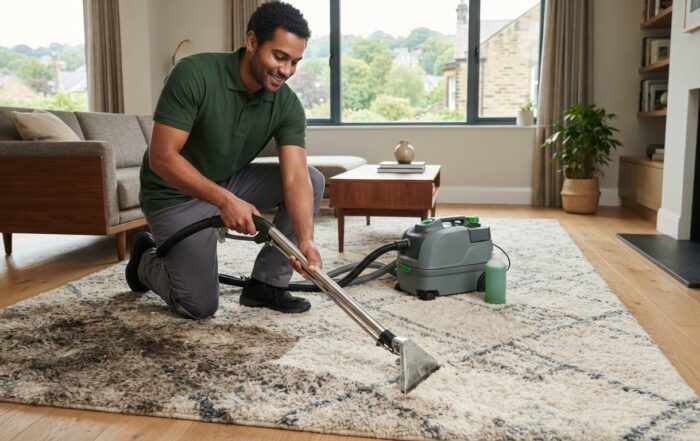
Hot water extraction pushes a cleaning solution into the carpet under pressure, then pulls it back out with the water and dirt.
Steam cleaning uses hot vapour with very little water.
For mildew problems, hot water extraction wins. Here’s why:
- It removes the moisture that mildew feeds on
- It flushes out the organic matter mould spores cling to
- It leaves less residue behind than shampoo methods
- It reaches the backing where the smell lives
For a small spot, a wet vacuum and a mildew-specific cleaner will do.
Add a capful of white vinegar to the rinse water. It helps reset the pH balance and discourages fungal growth without leaving a chemical smell.
Step 4: How to Dry Out Wet Carpet Quickly
Speed is everything. Carpet that stays damp for more than a day gives mildew a head start, and no deodoriser will outrun it.
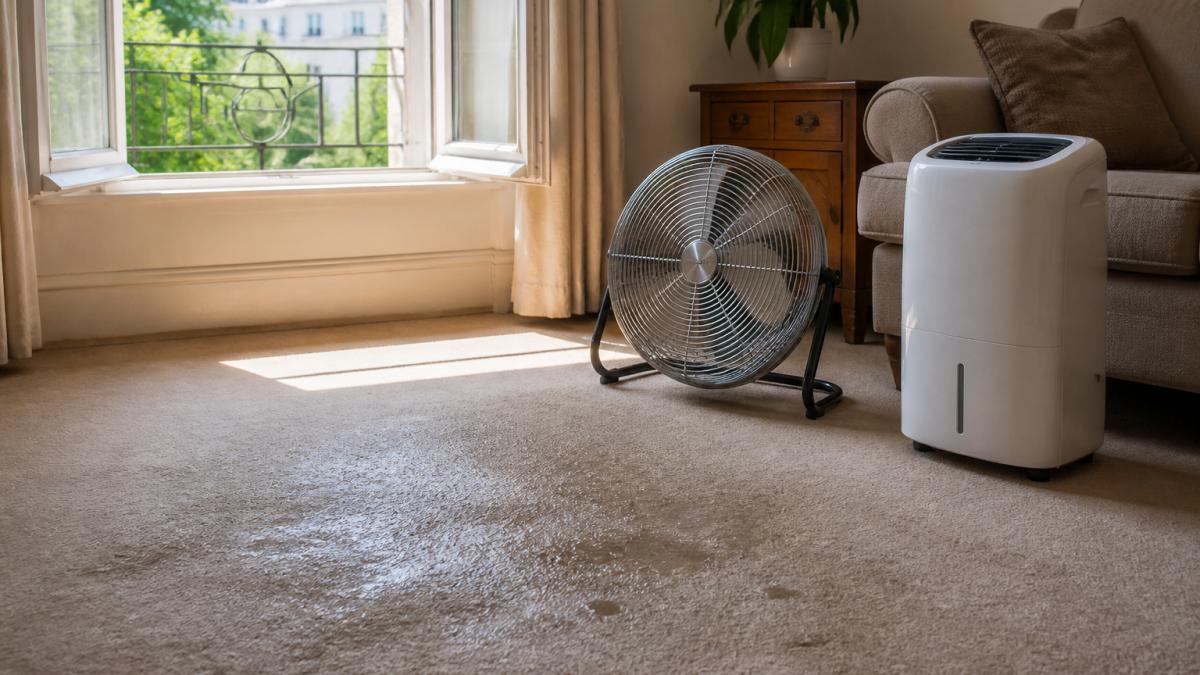
Follow this order:
- Blot any standing water with clean towels first, press, don’t rub
- Open windows and doors to get cross-ventilation moving
- Set up fans or an air mover angled across the carpet, not down at it
- Run a dehumidifier to pull moisture out of the air, not just move it around
- Turn on the heating in cool weather to raise the air’s moisture-holding capacity
- Keep the room ventilated and the dehumidifier running for at least 24 hours
Air circulation is the part people get wrong. A fan pointed straight down pushes moisture into the underlay. A fan angled across the surface pulls it up and away.
Humidity control is the step most guides skip
Drying a carpet is really a humidity problem. A room sitting above roughly 60% relative humidity will keep feeding mildew even after the carpet feels dry to the touch.
A dehumidifier is the single most useful tool here.
If you have central heating, running it gently with the windows cracked for short bursts can help, but avoid blasting hot air directly at the carpet, that can bake surface moisture in while leaving the backing damp.
How long should a carpet take to dry?
A common pattern is:
- Surface fibres: 4 to 8 hours with good airflow
- Backing: 12 to 24 hours
- Underlay: 24 to 48 hours, sometimes longer for thick foam or felt
Avoid walking on the carpet until it’s fully dry. Footsteps press dampness deeper into the padding. If the carpet still feels cool or clammy after a full day, it isn’t dry yet, and if the underlay is still damp after 48 hours, that’s your signal to lift the carpet and check whether the padding needs replacing rather than drying.
Run the dehumidifier overnight with the door closed and the fan still angled across the carpet. The combination of airflow and moisture removal does more in eight hours than a full day of open windows alone.
Step 5: Bicarbonate of Soda for Carpet Odours
Bicarbonate of soda for carpet odours works as an odour absorber, not a cleaner. It soaks up surface smells. It won’t kill mildew or remove the moisture causing it.
Use it after the carpet is fully dry, never before. Sprinkling powder onto a damp carpet makes a paste that traps more moisture.
Here’s the method:
- Vacuum the carpet thoroughly first
- Sprinkle a generous layer of bicarbonate of soda
- Leave it for at least 30 minutes, longer for stubborn smells
- Vacuum it up completely
- Repeat if the musty smell lingers
White vinegar is the other household option. Mix one part white vinegar with three parts water in a spray bottle, mist lightly over the dry carpet, and let it dry.
Neither method reaches the backing. If the smell returns within days, the problem is deeper than the surface.
Step 6: When to Call Professional Carpet Deep Cleaning Services
Professional carpet deep cleaning services are worth calling when the smell keeps returning, when the affected area is larger than a doormat, or when the carpet has been damp for more than two days.
DIY methods handle surface odours. They don’t fix moisture trapped in the padding, and they don’t kill spores already rooted in the backing.
Signs it’s time to call someone:
- The musty smell comes back within a week of cleaning
- You can see dark patches on the backing
- The underlay feels damp or spongy
- Someone in the home has allergies or asthma
- You’re a tenant facing a move-out inspection
At Carpet Cleaning In Stockport, our technicians use hot water extraction and pet-safe, family-friendly solutions to reach the layers a rental machine can’t.
If you’re a tenant with a deadline, book early. Leaving it until the week of your inspection is how deposits get lost.
Step 7: Preventing Mildew Smell from Coming Back
Prevention comes down to one word: dryness. Keep moisture out and mildew has nothing to feed on. But the detail that separates a carpet that stays fresh from one that smells again within a month is material-specific care, and knowing when the underlay is beyond saving. Maintaining this same vigilance extends to the structural integrity of your home, as consistent airflow and moisture control are just as essential when you prevent bathroom mold from compromising the walls adjacent to your dampest floors.
Match your prevention to your carpet fibre
Not all carpets behave the same way when damp, and the wrong treatment can do more damage than the mildew.
- Synthetic (polypropylene, polyester, nylon): The most forgiving. They absorb very little water, dry relatively fast, and tolerate most mild cleaning solutions. This is where bicarbonate of soda and diluted white vinegar are safest.
- Wool: Holds moisture far longer than synthetic and is vulnerable to both mildew and fibre damage. Never use bleach, strong alkalis, or enzyme cleaners on wool, they can strip the natural lanolin and leave the fibres brittle. Dry wool faster than you would synthetic, and use a wool-safe cleaner only.
- Natural plant fibres (sisal, jute, coir): Highly absorbent and prone to staining and shrinkage when wet. These are the hardest to save once mildew takes hold, and many practitioners recommend professional assessment rather than DIY treatment.
If you’re unsure what your carpet is made of, check the label on the reverse or the original fitting paperwork. Treating a wool carpet like a synthetic one is one of the most common ways a small mildew problem becomes a replacement job.
When the underlay is beyond saving
This is the part most guides skip. Underlay, especially cheap foam, is a sponge. Once mould roots into it, no amount of surface cleaning will fix the smell, because the odour is coming from beneath the carpet, not from the fibres you can see.
Signs the underlay needs replacing rather than cleaning:
- It crumbles or disintegrates when you lift a corner
- It feels spongy or stays damp more than 48 hours after the carpet surface is dry
- There’s visible dark speckling or a sharp musty smell when you peel the carpet back
- The smell returns within days of every clean
Replacing underlay is usually cheaper than replacing the carpet, and it’s the only reliable fix when the padding is contaminated. Lift the affected section, dispose of the old underlay, treat the subfloor, and fit new underlay before relaying the carpet.
The ongoing habits that actually work
- Fix leaks the day you spot them, not the week after
- Run a dehumidifier in bathrooms, kitchens, and any room that feels clammy, and keep humidity between 40% and 50%
- Open windows regularly to keep ventilation moving, especially after cooking, showering, or drying laundry indoors
- Use a doormat and ask people to remove wet shoes
- Blot spills immediately and extract, don’t just wipe
- Get carpets deep cleaned once or twice a year in busy homes
- Check underlay after any flooding or burst pipe, and replace it if it’s been wet for more than two days
Humidity control is the strategy most people never think about. A room that sits above 60% humidity will grow mildew on carpet, curtains, and even walls. A cheap hygrometer tells you where you stand, and a dehumidifier keeps you there.
If mildew keeps returning, stop treating the carpet and start treating the moisture, and check the underlay. The smell is a symptom, not the problem.
Frequently Asked Questions
How long does it take for mildew smell to go away from carpet?
With proper cleaning and drying, the smell can start to fade within 24 to 48 hours. However, if the mildew has penetrated the carpet padding or subfloor, it may take several days and require professional treatment. Ensuring the carpet dries completely is key; residual dampness will allow the smell to return.
What neutralizes mildew smell?
White vinegar and bicarbonate of soda are effective natural neutralizers. Vinegar kills mildew spores, while bicarbonate of soda absorbs odours. For severe cases, a mildew-specific cleaner or professional deodorizer may be needed. Always test on a small area first and ensure proper ventilation.
Can mildewed carpet be saved or should it be replaced?
If the mildew is limited to the surface and the carpet dries quickly, it can often be saved with deep cleaning. However, if the carpet backing or padding is extensively affected, replacement is the safer option to prevent recurring odours and health risks. A professional can assess the extent of the damage.
Is a mildew smell in carpet a health hazard?
Yes, mildew indicates mold growth, which can release spores and allergens into the air. This can cause respiratory issues, allergies, and other health problems, especially for children, the elderly, and those with compromised immune systems. Addressing the moisture source and cleaning thoroughly is important for a healthy indoor environment.