Table of Contents
- What Are Enzymatic and Standard Cleaners?
- How Enzymatic and Standard Cleaners Work
- Types of Enzymes and Their Targets
- How to Remove Pet Urine from Carpet
- How Long Do Enzyme Cleaners Take to Work?
- Enzymatic vs Standard Cleaners: Comparison Table
- When to Avoid Enzyme Cleaners
- Frequently Asked Questions
Last Updated: September 28, 2026
What Are Enzymatic and Standard Cleaners?
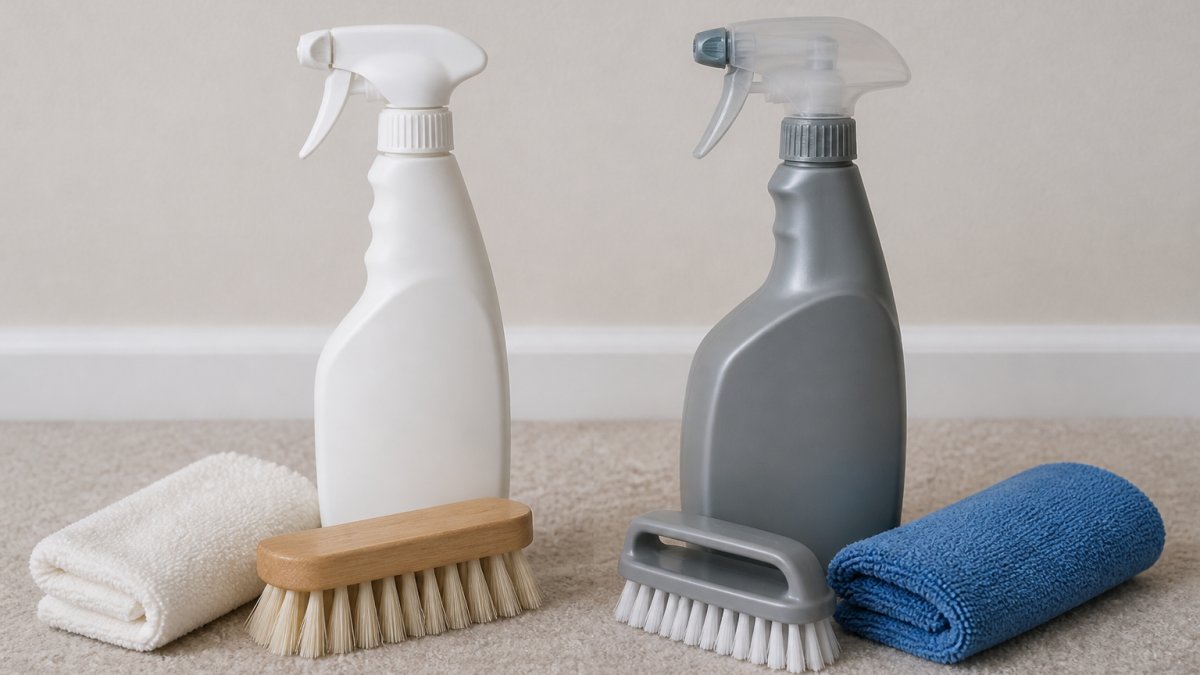
The difference in enzymatic vs standard cleaners comes down to how they remove dirt. Enzymatic cleaners use biological catalysts to break down organic residues at a molecular level, while standard cleaners rely on surfactants and solvents to lift dirt from the surface.
How Enzymatic and Standard Cleaners Work
Enzymes digest organic matter through a catalytic reaction, while standard cleaners physically lift dirt using surfactants and solvents.
The Science Behind Enzymatic Cleaners
Enzymes are biological catalysts (Enzymes: principles and biotechnological applications). Each targets a specific substrate, the molecule it is built to break down, speeding up a catalytic reaction that splits complex organic compounds into simpler, harmless pieces.
How Standard Cleaners Tackle Dirt
Standard cleaners take a physical and chemical approach. Surfactants reduce water’s surface tension so it can penetrate fabric fibres, lift dirt, and hold it in suspension until extraction.
Types of Enzymes and Their Targets
Different enzymes target different organic compounds. The three most common in household cleaning products are protease, lipase, and amylase, each built to break a specific chemical bond.
- Protease breaks down proteins by hydrolysing peptide bonds. It handles urine, blood, vomit, faeces, and protein-rich food spills.
- Lipase breaks down lipids and fats by hydrolysing ester bonds in triglycerides. It targets grease, cooking oils, dairy, and sebum.
- Amylase breaks down starches by hydrolysing glycosidic bonds. It works on sauces, gravy, baby food, and sugary spills.
- Cellulase (less common) breaks down cellulose; in cleaning it modifies cotton fibres, which is why it appears in some laundry detergents rather than carpet sprays.
- Mannanase and pectinase appear in some blends for food stains such as tomato, chocolate, and fruit.
How to Read an Enzyme Label
When you read a label, look for enzymes listed by name. A product that says “enzymatic” without naming them is usually a light blend with limited range. Check:
- Named enzymes, protease, lipase, amylase, and so on. If none are named, assume a token amount.
- Activity units, some manufacturers state activity in units per millilitre. Higher is not automatically better, but it signals performance-led formulation.
- pH range, most cleaning enzymes work best between roughly pH 6 and pH 9. A strongly acidic or alkaline formula will have denatured its own enzymes before you open the bottle.
- Preservatives and biocides, antibacterial agents can be useful but may interfere with the enzyme blend, so check whether the product is marketed as both enzymatic and antibacterial.
What Kills an Enzyme
Enzymes are proteins themselves, so they are fussy about their environment. Three things denature them:
- Heat, above roughly 50°C, the protein structure unfolds and the enzyme stops working. Never use hot water with an enzymatic product.
- Extreme pH, bleach, ammonia, and many acidic descalers push the pH outside the enzyme’s working range and destroy it on contact.
- Time and storage, enzymes degrade slowly even sealed. Most products last around one to two years unopened, less once diluted. Store cool, out of direct sunlight, and check the date.
If you are treating a stain on a surface you have previously cleaned with bleach or a strong bathroom spray, rinse the area with cool water first. Residual bleach on the surface can neutralise the enzymes before they have a chance to work.
Which Enzyme for Which Stain
| Stain type | Target enzyme | Notes |
|---|---|---|
| Pet urine, blood, vomit | Protease | Also needs to reach uric acid crystals in the backing |
| Cooking oil, grease, dairy | Lipase | Works best with a longer dwell time |
| Gravy, sauces, baby food | Amylase | Often paired with protease for mixed food stains |
| Tomato, fruit, chocolate | Mannanase, pectinase | Usually found in multi-enzyme blends |
A multi-enzyme blend is the practical household choice because most real stains are mixtures. A single-enzyme product is only worth buying if you know exactly what you are treating.
How to Remove Pet Urine from Carpet
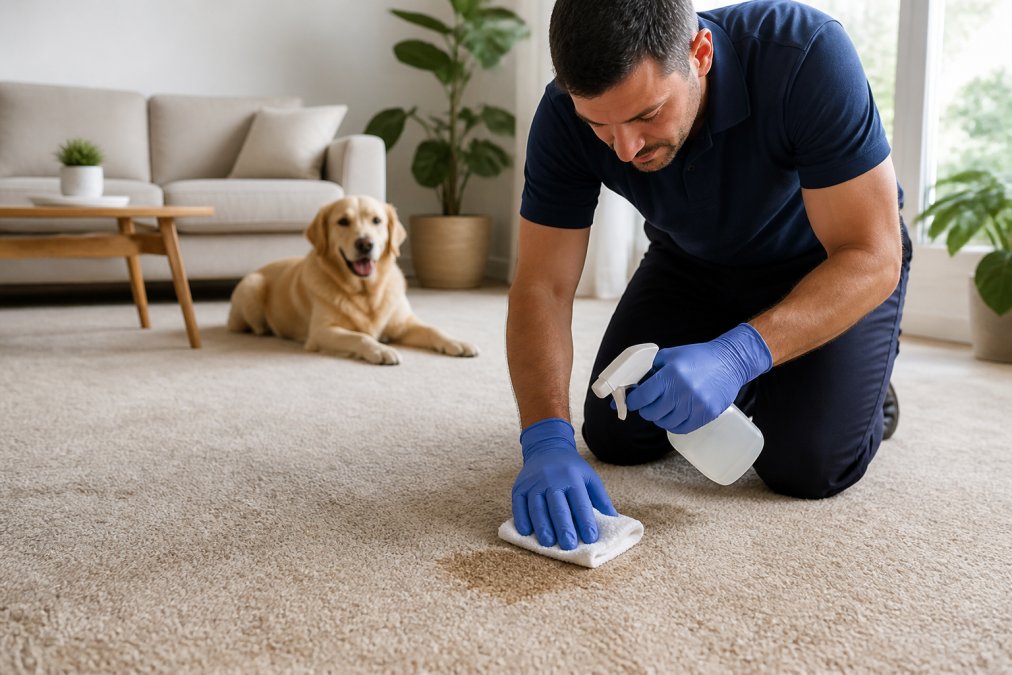
To remove pet urine from carpet, treat it as an organic contamination problem, not a surface stain. Urine contains urea, uric acid crystals, and proteins that bind to carpet fibres and soak into the backing.
Here is the process that actually works:
- Blot fresh urine immediately with a clean cloth. Press, do not rub.
- Apply an enzymatic cleaner generously so it reaches the backing, not just the surface.
- Allow full dwell time. The enzymes need time to digest the uric acid.
- Blot again, then rinse with cool water to remove residue.
- Air dry thoroughly. Damp backing encourages microbial activity.
How Long Do Enzyme Cleaners Take to Work?
Enzyme cleaners typically need 10 to 30 minutes of dwell time, though heavy or set-in stains may need several hours. The enzymes must stay wet to remain active, so drying out too early stops the catalytic reaction.
Enzymatic vs Standard Cleaners: Comparison Table
The table below summarises how enzymatic and standard cleaners differ across the factors that matter most.
| Factor | Enzymatic Cleaners | Standard Cleaners |
|---|---|---|
| How they work | Digest organic matter via enzymes | Lift dirt with surfactants or solvents |
| Best for | Pet urine, protein, fat, odour | Routine dirt, grease, surface grime |
| Dwell time | 10-30 minutes or longer | Near-instant |
| Odour removal | Neutralises at the source | Masks temporarily |
| Material safety | Gentle on most fibres | Varies; some are harsh |
| Storage | Cool, dry, check shelf life | Generally stable |
| Cost per use | Higher per application | Lower per application |
Two things competitors rarely mention: shelf life and mixing.
When to Avoid Enzyme Cleaners
Enzymatic cleaners are not right for every job. Sometimes a standard cleaner or professional service is better, and on a few surfaces the wrong product can cause permanent damage.
Stains Enzymes Cannot Touch
Enzymes are substrate-specific. If a stain is not a protein, fat, or starch, there is nothing for the enzyme to digest.
- Ink, wine, and dye-based stains, pigments and tannins, not organic residues. Enzymes have no target, so you pay a premium for no benefit.
- Rust and mineral deposits, inorganic. You need an acidic descaler, not an enzyme.
- Fresh grease or oil spills, a solvent-based cleaner lifts these faster than enzymes can digest them. Enzymes suit the residue left after the bulk of the grease is removed.
- Urgent spills, enzymes need dwell time. If you need the surface usable immediately, a standard cleaner is faster.
Material Compatibility: Where Enzymes Can Cause Harm
This is the part most guides skip: enzymes are gentle on most synthetic fibres, but not universally safe.
| Surface or material | Enzymatic cleaners | Standard cleaners |
|---|---|---|
| Polypropylene, polyester, nylon carpet | Safe | Safe |
| Wool and silk | Use with caution, protease can attack protein fibres | Check the care label; some are safe, some are not |
| Leather and suede | Avoid, protease can degrade the protein structure | Use a dedicated leather cleaner |
| Natural stone (marble, travertine, limestone) | Avoid, many formulas are alkaline and can etch the surface | Avoid acidic cleaners; use a pH-neutral stone cleaner |
| Sealed hardwood | Safe if the seal is intact | Avoid excess water; use a damp-mop method |
| Grout and tile | Safe | Safe |
| Aluminium and some metals | Generally safe | Avoid strongly alkaline or acidic products |
Always test an enzymatic cleaner on a hidden area first, a scrap of carpet in a wardrobe, the underside of a cushion, or an offcut of the same material. Wait the full dwell time, then blot dry and check for colour change, fibre damage, or residue before treating the visible area.
Mixing Warnings: What Neutralises Enzymes
Enzymes are pH-sensitive proteins. Mixing them with the wrong chemical does not just dilute them, it destroys them.
- Bleach (sodium hypochlorite), strongly alkaline and oxidising; it denatures enzymes on contact. Never combine the two, and never use bleach on a stain you plan to treat with enzymes afterwards without rinsing thoroughly first.
- Ammonia, alkaline; it pushes the pH outside the enzyme’s working range and stops the reaction.
- Vinegar and acidic descalers, low pH; same problem in the opposite direction.
- Standard multipurpose sprays, many contain surfactants, solvents, or biocides that interfere with enzyme activity. Use one product or the other, not both.
- Hydrogen peroxide, an oxidiser; useful on some stains, but it neutralises enzymes if applied at the same time.
When to Call a Professional
There is a practical limit to what any consumer product can do. When urine has soaked through to the underlay, when a stain has been set for months, or when the material is wool, silk, leather, or natural stone, surface products cannot reach the contamination and may cause damage trying. That is when professional extraction with an enzymatic pre-treatment, matched to the fibre and the stain, can be highly effective.
Frequently Asked Questions
What is the main difference between enzymatic and standard cleaners?
Enzymatic cleaners use biological catalysts like protease, lipase, and amylase to break down organic residues such as proteins, fats, and starches. Standard cleaners rely on surfactants and solvents to lift dirt from surfaces. Enzymatic cleaners digest the source of stains and odours, while standard cleaners remove surface grime. This makes enzymatic cleaners better for pet accidents, food spills, and persistent smells.
Do enzymatic cleaners actually kill bacteria?
Enzymatic cleaners do not directly kill bacteria; they break down the organic waste that bacteria feed on. By removing this food source, they reduce bacterial action and odours over time. Some products include disinfectants, but the enzymes themselves target stains and residues. For true disinfection, you may need a separate EPA-approved disinfectant, but enzymatic cleaners are effective for odour neutralisation and stain removal.
When should you use an enzymatic cleaner instead of a standard one?
Use enzymatic cleaners for organic stains like pet urine, vomit, blood, and food grease. They are ideal when odours persist after standard cleaning, as they break down the source. Standard cleaners work well for general dirt, dust, and light spills. For high-traffic areas or synthetic stains, standard cleaners may suffice. If you have pets or young children, enzymatic cleaners offer a non-toxic, eco-friendly option.
Are enzymatic cleaners safe for all carpet types?
Most enzymatic cleaners are safe for common carpet fibres like nylon, polyester, and wool when used as directed. However, always test on a hidden area first, especially for delicate fabrics like silk or viscose. Avoid over-wetting, as excess moisture can damage backing. Check the label for pH neutral formulas, which are gentler on surface integrity. If unsure, consult a professional cleaner.
Can you mix enzymatic cleaners with standard detergents?
No, mixing enzymatic cleaners with standard detergents or disinfectants can inhibit enzyme activity. Many standard cleaners contain chemicals that break down enzymes, making them ineffective. Always use enzymatic products alone, and allow proper dwell time. If you need to clean first, use a standard cleaner, rinse thoroughly, then apply the enzymatic cleaner separately. This ensures the enzymes can digest organic residues without interference.